

Anemia often occurs in patients with pathology of the cardiovascular system: it could be observed in the third part of patients with congestive heart failure and in 10-20% of patients with ishemic heart disease (IHD).
The mortality rate in patients with hemodilution was more than two times higher than that in patients with other causes of anemia in CHF (A.S. Androne et al) The causes of anemia in heart diseases are multifactorial: hemodilution (increase in the volume of circulating plasma), due to the activation of the RAAS and the vasopressin system, which leads to fluid retention in the patient's body; impaired renal function and decrease in the production of erythropoietin (CHF is often combined with varying degrees of chronic renal failure (CRF), which develops due to renal vasoconstriction and ischemia and could also lead to the development of anemia due to decrease in renal secretion of erythropoietin);
Causes of anemia in CHF: 24% - renal dysfunction, 5% - iron deficiency, 5% - folic acid deficiency, 3% - hemodilution, 5% - thalassemia, 57% - anemia of chronic diseases (Opasich et al) activation of cytokines (in patients with CVD, the level of pro-inflammatory cytokines increases as the disease progresses. Tumor necrosis factor (TNF), interleukin-1 and interleukin-6 have direct effect on bone marrow function and contribute to the development of anemia of chronic diseases. TNF activation also reduces sensitivity receptors for erythropoietin, disrupts the release and iron utilization); iron deficiency (associated with decreased food intake (cardiac cachexia), malabsorption syndrome, use of aspirin for prophylactic purposes); the effects of drugs (therapy with ACE inhibitors could reduce concentration of hemoglobin by reducing the renal secretion of erythropoietin); anemia of chronic diseases (hepcidin reduces the level of iron in the blood, preventing its absorption from gastrointestinal tract and decreasing release from macrophages).
Scheme of the pathophysiological events in CHF sequence contributing to the development of anemia
Due to tissue hypoxia, vasodilation occurs, followed by decrease in blood pressure, which ultimately leads to the activation of sympathetic nervous system (SNS). Increase in sympathetic tone leads to narrowing of the renal arteries with subsequent activation of the renin-angiotensin-aldosterone system (RAAS), increase in the level of angiotensin II. As a result, even greater increase in vascular resistance, decrease in renal blood flow and filtration rate in the renal glomeruli and ischemia of the renal parenchyma occur. Resulting renal failure, in which the production of erythropoietin (EPO) and bone marrow activity is reduced, could cause anemia, and increase in aldosterone production contributes to sodium and fluid retention. Thus, a significant increase in the volume of plasma and interstitial fluid occurs, which causes dilatation of the cardiac cavities and peripheral edema.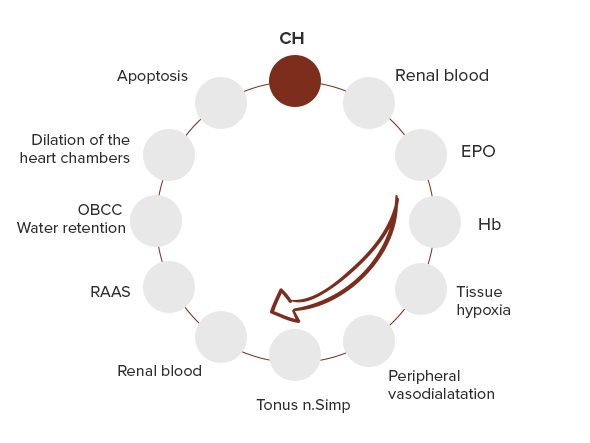
The long-term consequences of the interaction of all the above factors have negative effect on heart and cardiovascular system as a whole. On one hand, as a result of increase in heart rate and stroke volume, myocardial oxygen demand increases, on the other hand, as a result of anemia, oxygen transport in blood decreases. There is "remodeling" of the myocardium with dilatation and hypertrophy of the left ventricle. This ultimately leads to apoptosis and necrosis of myocardial cells, progression of fibrosis, cardiomyopathy and further - CHF. Along with this, the secretion of cytokines such as tumor necrosis factor alpha (TNF-a), interleukin-1 and -6, which themselves could cause anemia, are increased.
Use of iron preparations in patients with CHF reduces the occurrence of repeated vascular accidents by 22.4%. In addition, use of these medications increases exercise tolerance, improving the functional class of CHF. Anemia is an independent risk factor for poor outcome in cardiovascular disease. 1.The risk of death with CHF in patients with anemia is two times higher than without it. 2.In acute coronary syndrome, the presence of anemia could quadruple the likelihood of death in patients and is considered an independent predictor of the risk of adverse clinical outcomes. 3. Preoperative anemia during cardiac surgery determines the high risk of subsequent blood transfusion and worse treatment results. Treating these patients is a daunting task. When choosing the treatment individually, the doctor should take into account the patient's condition and concomitant diseases.
© 2026 
